Form 7-1 Solar Power Generation System Input Sheet
In the “Form 7-1. (Efficiency Improvement) Solar Power Generation System” input sheet, enter the type of photovoltaic cells, the system capacity of the array, etc., based on the drawings that describe the specifications of the solar power generation system.
When the solar power generation equipment is installed across both shared residential areas and non-residential buildings, the following procedure shall be applied:
(1) First, determine the amount of self-consumption in the shared residential areas, in accordance with “Evaluation of Solar Power Generation Equipment in Shared Residential Areas (Calculation and Judgment Methods and Commentary for Non-Residential Buildings, based on the 2013 Energy Conservation Standard (2nd Edition), p. 328),” published on the website of the Building Research Institute.
(2) Then, the amount of electricity supplied to the non-residential part shall be the total generated electricity minus the self-consumption amount of the shared residential areas. The above procedure shall be regarded as the basic procedure.
When solar power generation equipment is installed on another building within the same premises, and the buildings share the same power supply system, and no electricity is sold, the evaluation shall be conducted as follows.
(a) When the generated electricity is supplied only to the building subject to calculation:
All the solar power generation equipment shall be considered to contribute to the building subject to calculation, and the total system capacity shall be entered.
(b) When the generated electricity is supplied also to buildings other than the building subject to calculation:
The total system capacity shall be apportioned according to the annual electricity consumption (calculated value) or the total floor area, and the prorated system capacity considered to contribute to the building subject to calculation shall be entered.
As an exception, even if solar power generation equipment is installed, it is also permissible to undergo review and inspection without preparing this Form 7-1, treating the building as if no solar power generation equipment were installed. In that case, the energy-saving effects of the solar power generation equipment shall not be reflected at all in the design primary energy consumption.
Format of the Solar Power Generation System Input Sheet
The “Form 7-1. (Efficiency Improvement) Solar Power Generation System” input sheet is shown in Figure 7-1-1.
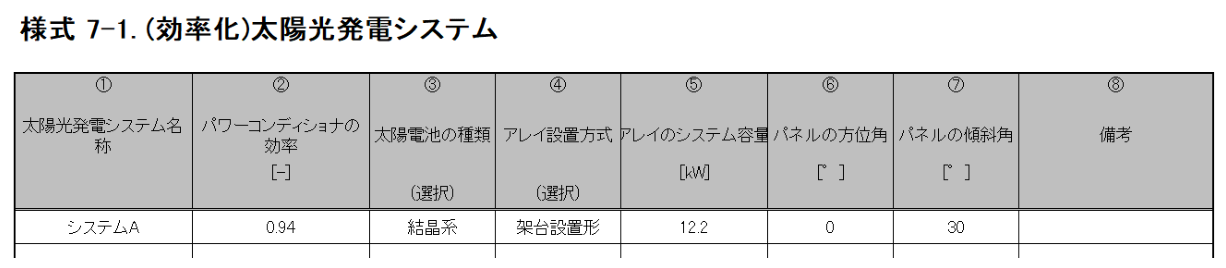
Input Items and Input Method of the Solar Power Generation System Input Sheet
The input items and input methods of the “Form 7-1. (Efficiency Improvement) Solar Power Generation System” input sheet are shown below. The numbers in brackets preceding each Input item correspond to the numbers in brackets shown at the top of Figure 7-1-1.
(1) Name of Solar Power Generation System
- Enter the name of the Solar Power Generation System as a character string. In the Energy Consumption Performance Calculation Program (Non-Residential Version), each system is identified by this name, so care must be taken to ensure that names are not duplicated.
(2) Efficiency of Power Conditioner
- -JIS C 8961: Enter the rated load efficiency of the power conditioner measured in accordance with “JIS C 8961:2008 — Methods of Measuring the Efficiency of Power Conditioners for Photovoltaic Power Generation Systems.”
- If the value is unknown, use 0.928.
(3) Type of Photovoltaic Cell
- Select and enter the type of photovoltaic cell from the options in Table 7-1-1.
| Option | Application |
|---|---|
| Crystalline | Solar cells using monocrystalline or polycrystalline silicon as the semiconductor material |
| Non-crystalline | Solar cells using semiconductor materials other than monocrystalline or polycrystalline silicon |
(4) Array Installation Method
- Select and enter the installation method of the array (method of mounting photovoltaic arrays) from the options in Table 7-1-2.
| Option | Application |
|---|---|
| Other | Other than the below (building-integrated, wall-mounted, etc.). |
| Rack-mounted type | Solar cell arrays in which the modules are installed indirectly with a gap from the roof, other than the roof-mounted type. |
| Roof-mounted type | Solar cell modules installed indirectly, parallel to the roof with a gap. |
(5) Array System Capacity
- Enter the system capacity of the photovoltaic array.
- If the system output of the photovoltaic array is unknown, the total of the standard photovoltaic module output per module for all photovoltaic modules that constitute the relevant array may be entered as the system capacity of the photovoltaic array.
- A photovoltaic array refers to an assembly in which photovoltaic modules or photovoltaic panels are mechanically integrated and interconnected. The system capacity (unit: kW) of the installed photovoltaic array shall be verified and entered in accordance with the following methods:
1) When you can confirm the value of “standard photovoltaic array output,” measured in accordance with “JIS C 8951 — General Rules for Photovoltaic Arrays” and indicated in accordance with “JIS C 8952 — Method of Marking for Photovoltaic Arrays,” enter that value.
2) When the "standard photovoltaic array output" is not indicated, enter the total of the standard photovoltaic module outputs per module stated in the manufacturer’s specification sheet or technical documentation, etc., which are described in accordance with the JIS standards listed in Table 7-1-3.
| Type of solar cell | Condition |
|---|---|
| Crystalline solar cells | JIS C 8918, JIS C 8990, or IEC 61215 |
| Non-crystalline solar cells (amorphous solar cells, multi-junction solar cells, etc.) | JIS C 8991 or IEC 61646 |
| Amorphous solar cells, etc. | JIS C 8939 |
| Multi-junction solar cells | JIS C 8943 |
(6) Azimuth Angle of Panels
- Enter the azimuth angle of the panels. The unit is degrees (°).
- South is defined as 0°, and the angle increases westward. Therefore, west = 90°, north = 180°, and east = 270°.
(7) Inclination Angle of Panels
- Enter the inclination angle of the panels. The unit is degrees (°).
- Horizontal = 0°, vertical = 90°.
(8) Remarks
- This field is for memos during data entry and is not used in the calculation, so entry is optional.