Form 2-3 Window Specifications Input Sheet
Refer to the design drawings (such as the Exterior Finishing Table or Building Fixtures List) that describe the window specifications (materials, thickness) and enter information related to the type and physical properties of the glass in the “Form 2-3 (Air Conditioning) Window Specifications” input sheet.
The information entered in this sheet shall be used in "Form 2-4. (Air Conditioning) Envelope Specifications" input sheet.
Format of the Window Specifications Input Sheet
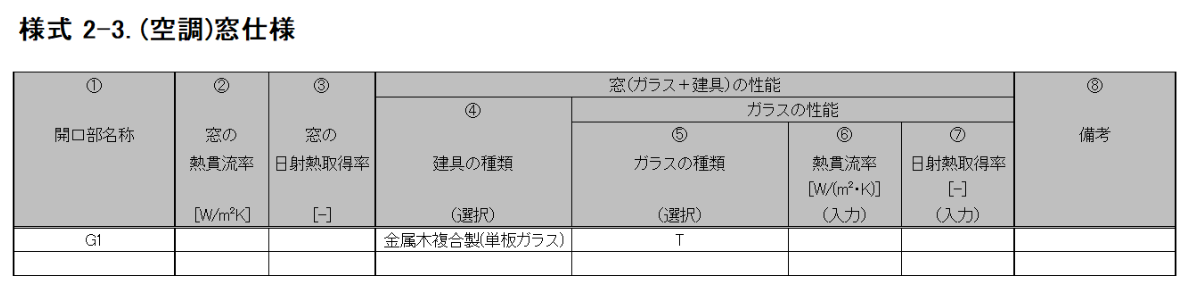
The format of “Form 2-3. (Air Conditioning) Window Specifications” input sheet is shown in Figure 2-3-1.
Input Items and Input Method of the Window Specifications Input Sheet
The input items and input methods of the “Form 2-3. (Air Conditioning) Window Specifications” input sheet are shown below. The numbers in brackets preceding each item name correspond to the numbers in brackets shown at the top of Figure 2-3-1.
(1) Name of Opening
- Enter the name of the window (glass + building fixture) using any desired character string.
- In the Energy Consumption Performance Calculation Program (Non-residential Version), windows are identified by these names; therefore, care must be taken to ensure that names are not duplicated.
Hereafter, the specifications for each opening are to be entered using one of the following three methods. If overlapping entries exist, priority shall be given in the following order: (c) first, followed by (b), then (a).
a) Enter “(4) Building Fixture Type” and “(5) Glass Type.”
b) Enter “(4) Building Fixture Type,” “(6) Thermal Transmittance of Glass,” and “(7) Solar Heat Gain Coefficient of Glass.”
c) Enter “(2) Thermal Transmittance of Window” and “(3) Solar Heat Gain Coefficient of Window.”
(2)(3) Thermal Transmittance and Solar Heat Gain Coefficient of Window
- Enter numerical values for the thermal transmittance and solar heat gain coefficient of the window (glass + building fixture).
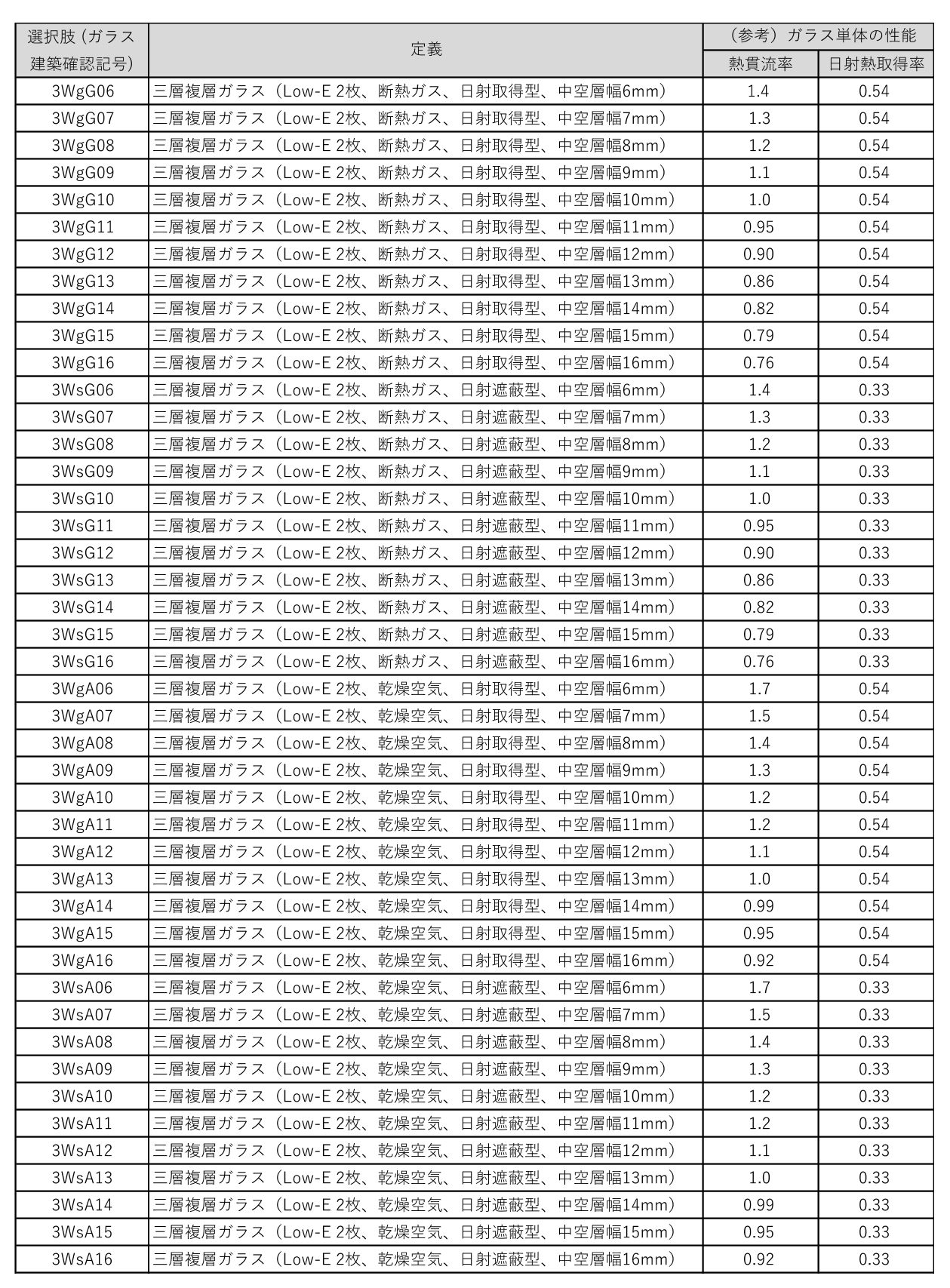
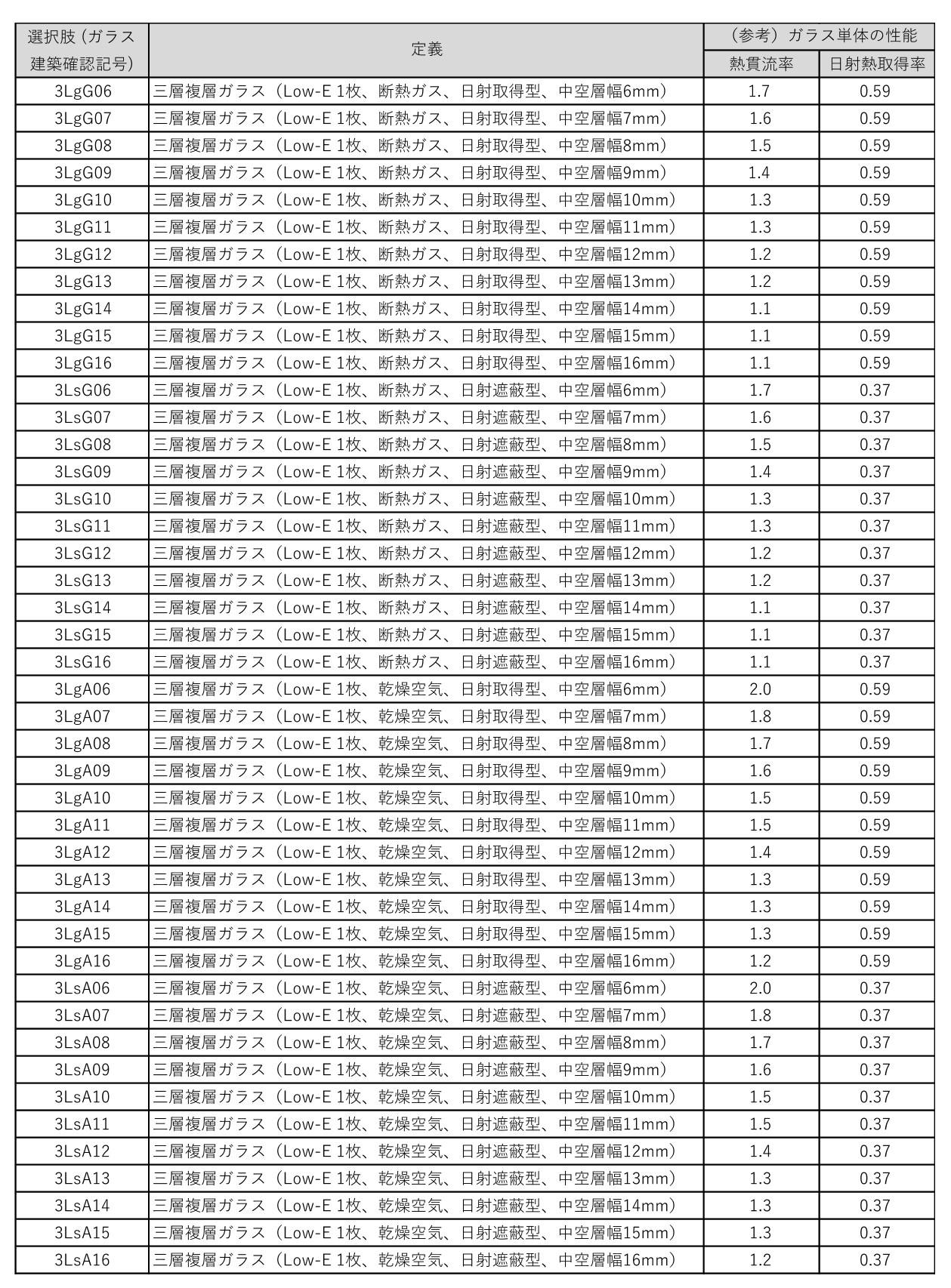
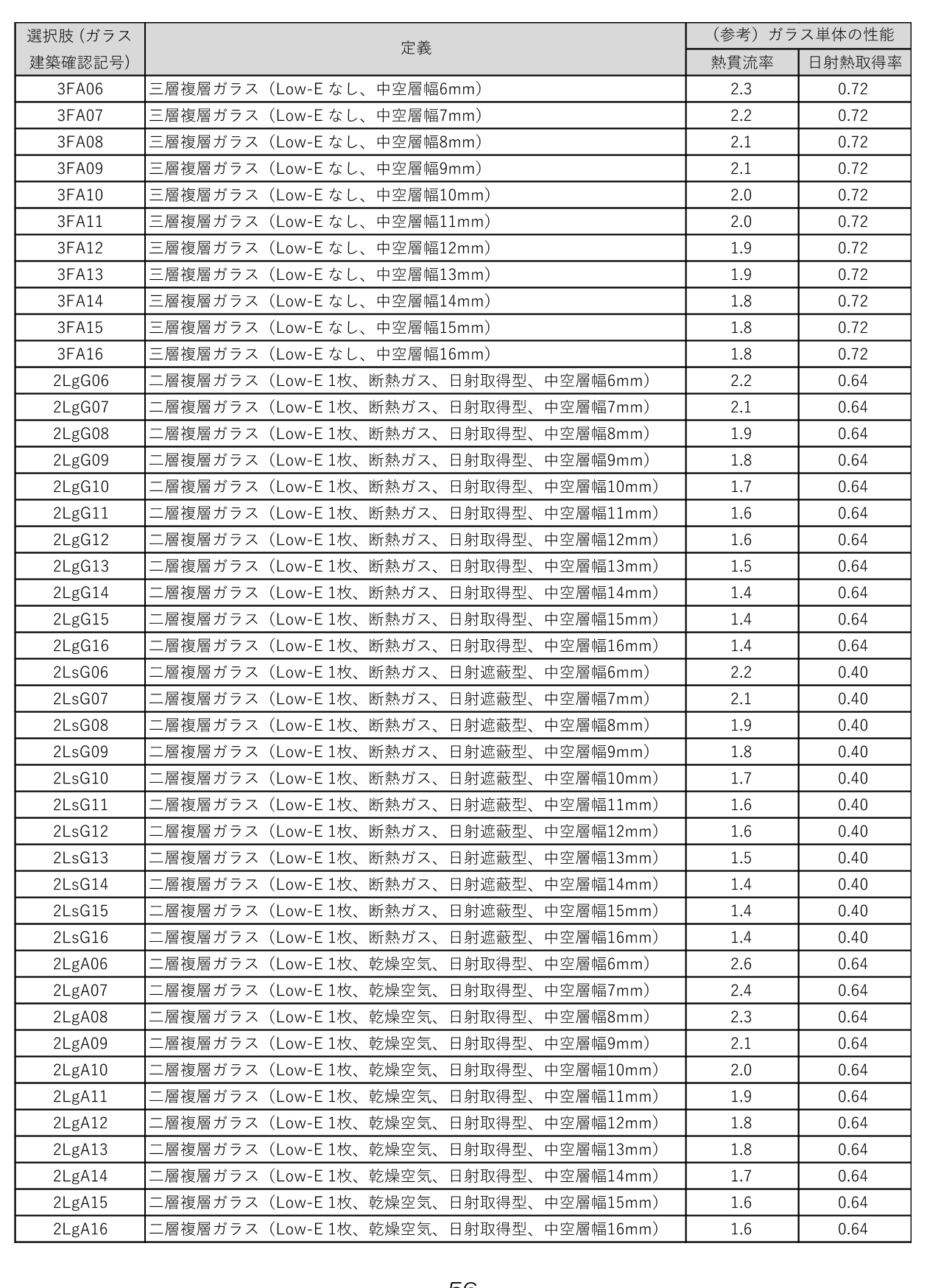
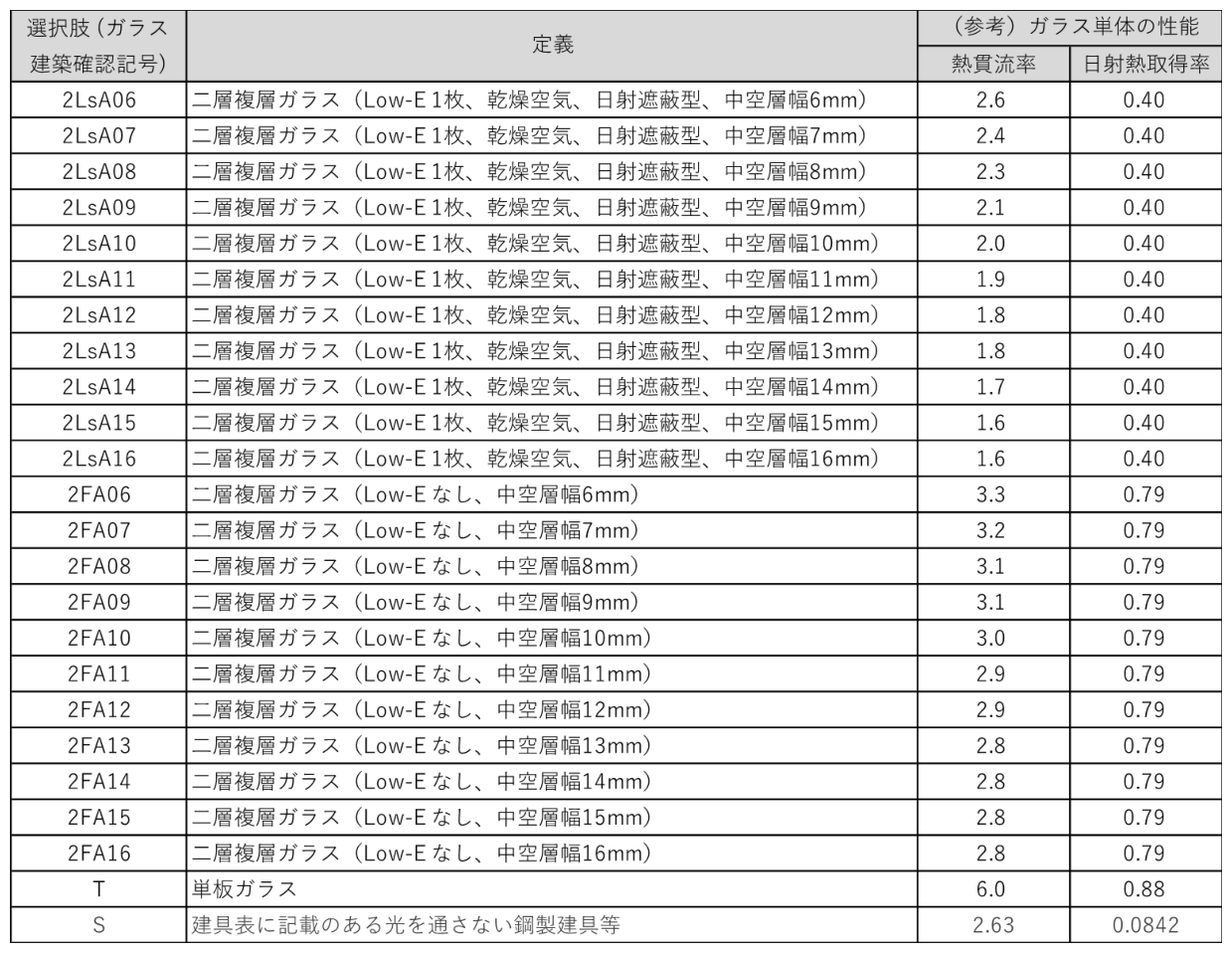
- When it is desired to specify the performance values of a window in detail, such as when using a special type of glass that is not defined in Table 2-3-2 “List of Types and Physical Properties of Glass,” leave (4), (5), (6), and (7) blank and enter the values in (2) and (3). In this case, the calculation basis for both values must be submitted separately.
- When specifying the type of building fixture and glass in (4) and (5), or the type of building fixture and performance of glass in (4), (6), and (7), leave (2) and (3) blank.
- If blinds are installed on the window and the thermal transmittance and solar heat gain coefficient considering the effect of blinds are entered, then in the item “(8) Presence or Absence of Blinds” of the later-mentioned “Form 2-4 (Air Conditioning) Envelope Specifications Input Sheet,” enter “None” to prevent double counting.
- The value of thermal transmittance for the window shall, in principle, be obtained using one of the following methods:
JIS A 4710 (Test method for thermal insulation performance of building fixture)
JIS A 1492 (Test method for thermal insulation performance of bay windows and skylights)
Calculation method for thermal insulation performance stipulated in JIS A 2102-1 (Thermal performance of windows and doors — Calculation of thermal transmittance — Part 1: General), and JIS A 2102-2 (Thermal performance of windows and doors — Calculation of thermal transmittance — Part 2: Numerical calculation method for frames)
ISO 10077-1 (Thermal performance of windows, doors and shutters --Calculation of thermal transmittance -- Part 1: Calculation method for thermal insulation performance stipulated in ISO 10077-1 (Thermal performance of windows, doors and shutters --Calculation of thermal transmittance -- Part 1: General)
Calculation method for thermal insulation performance stipulated in ISO 15099 (Thermal performance of windows, doors and shading devices — Detailed calculations)
When using a thermal transmittance value obtained by the above methods, the test specimens specified in the following document may be used:
Method for Calculating Energy Consumption Performance (Residential Buildings)
Standards Defining the Range of Evaluation Products Recognized as Having Performance Equivalent to the Test Specimens for Thermal Transmittance of Windows and Doors
- The value of solar heat gain coefficient of window shall, in principle, be obtained using one of the following methods:
JIS A 1493 (Thermal performance of windows and doors — Measurement of solar heat gain coefficient)
JIS A 2103 (Thermal performance of windows and doors — Calculation of solar heat gain coefficient)
- For double windows (where two sets of building fixtures are installed), the thermal transmittance 𝑈𝑑,𝑖 and solar heat gain coefficient 𝜂𝑑,𝑖 shall be calculated using the following formulas. In these calculations, it is permissible to assume that the heat-transfer opening area 𝐴𝑒x,𝑖 and 𝐴𝑖n,𝑖 are equal. The values of U𝑑,ex,i, U𝑑,in,i, 𝜂𝑑,ex,𝑖, 𝜂𝑑,in,𝑖 shall be based on the performance values obtained from the standards such as JIS etc., specified in (2) Thermal Transmittance of Window and (3) Solar Heat Gain Coefficient of Window, or the values specified in the “Performance Values of Windows Assumed under the 2016 Standard (Window Performance Values depending on Type of Building Fixture and Glass)” published on the website of the Building Research Institute (BRI).
Where:
Thermal transmittance of the outside-air-side window of window i [W/m²K]
Thermal transmittance of the indoor-side window of window i [W/m²K]
Heat-transfer opening area of the outside-air-side window of window i (as defined in JIS A 4710) [m²]
Heat-transfer opening area of the indoor side window of window i (as defined in JIS A 4710) [m²]
Sum of the surface heat transfer resistances of the outdoor-air-side and indoor-side windows (assumed to be 0.17) [m²K/W]
Thermal resistance of the cavity layer of double-sash windows (assumed to be 0.173) [m²K/W]
Where:
Solar heat gain coefficient of the outside-air-side window (vertical plane) of window i [-]
Solar heat gain coefficient of the indoor-side window (vertical plane) of window i [-]
Ratio of the glass area to the total window area of window i (If both the indoor-side and outdoor-side window frames are made of wooden or resin building fixtures, use 0.72, otherwise, use 0.80).
- For double-skins and window systems (air-flow windows and push-pull windows), the thermal transmittance and solar heat gain coefficient shall be calculated and entered based on the “Method for Calculating Thermal Transmittance and Solar Heat Gain Coefficient of Double-Skins and Window Systems” published on the website of the Building Research Institute (BRI).
- For opaque steel building fixtures or boards, etc., in spandrel sections of glass curtain walls described in the Building Fixtures List, the provisional value of 2.63 may be used for Thermal Transmittance, and 0.0842 (=2.63×0.032) for Solar Heat Gain Coefficient, for the time being. If any value other than the above is entered, the calculation basis for that value must be submitted separately.
(4) Building Fixture Type
- When no values are entered in (2) and (3), select the corresponding building fixture type from Table 2-3-1 “Options for Building Fixture Type.”
| Option | Application |
|---|---|
| Plastic frame (single glazing) | Plastic-frame windows (when single glazing is used) |
| Plastic frame (double glazing) | Plastic-frame windows (when double glazing is used) |
| Plastic frame (triple or more glazing) | Plastic-frame windows (when triple or more multi-layer glazing is used) |
| Wooden frame (single glazing) | Wooden-frame windows (when single glazing is used) |
| Wooden frame (double glazing) | Wooden-frame windows (when double glazing is used) |
| Wooden frame (triple or more glazing) | Wooden-frame windows (when triple or more multi-layer glazing is used) |
| Metal-plastic composite frame (single glazing) | Windows with frames made of metal-plastic composite material (when single glazing is used) |
| Metal-plastic composite frame (double glazing) | Windows with frames made of metal-plastic composite material (when double glazing is used) |
| Metal-plastic composite frame (triple or more glazing) | Windows with frames made of metal-plastic composite material (when triple or more multi-layer glazing is used) |
| Metal-wood composite frame (single glazing) | Windows with frames made of metal-wood composite material (when single glazing is used) |
| Metal-wood composite frame (double glazing) | Windows with frames made of metal-wood composite material (when double glazing is used) |
| Metal-wood composite frame (triple or more glazing) | Windows with frames made of metal-wood composite material (when triple or more multi-layer glazing is used) |
| Metal frame (single glazing) | Metal-frame windows and other windows not listed above (when single glazing is used) |
| Metal frame (double or more glazing) | Metal-frame windows and other windows not listed above (when double or more multi-layer glazing is used) |
(5) Type of Glass
- Select the glass symbol from Table 2-3-2 “List of Types and Physical Properties of Glass,” and enter it as a character string.
- The selection options do not vary by glass thickness. When the cavity layer width is 6 mm or less, select “Cavity Layer Width 6 mm”; when it is 16 mm or more, select “Cavity Layer Width 16 mm.”
- For glass blocks, select “T.”
- If no corresponding glass type exists, after entering (4), leave (5) blank and proceed to enter values in (6) and (7).
- For opaque steel building fixtures, etc., listed in the Building Fixtures List, select “Metal (single pane glass)” for (4) Building Fixture Type and “S” for (5) Type of Glass.
- For automatic doors, if the specification of the glass portion is unknown, select “Metal (single pane glass)” for (4) Building Fixture Type and “T” for (5) Type of Glass.
(6)(7) Thermal Transmittance and Solar Heat Gain Coefficient of Glass
- Enter the values for the thermal transmittance and solar heat gain coefficient of the glass itself.
- The value of thermal transmittance shall, in principle, be obtained using one of the following methods:
JIS R 3107 (Method for calculating thermal resistance and thermal transmittance of flat glass and glazing used in buildings)
- The value of solar heat gain coefficient shall, in principle, be obtained using one of the following methods:
JIS R 3106 (Test methods for transmittance, reflectance, emittance, and solar heat gain coefficient of flat glass)
- Within the calculation program, these are automatically converted to the overall thermal transmittance and solar heat gain coefficient of the window (glass + building fixture).
(This table is provided in Japanese. An HTML version is planned for a future update.)
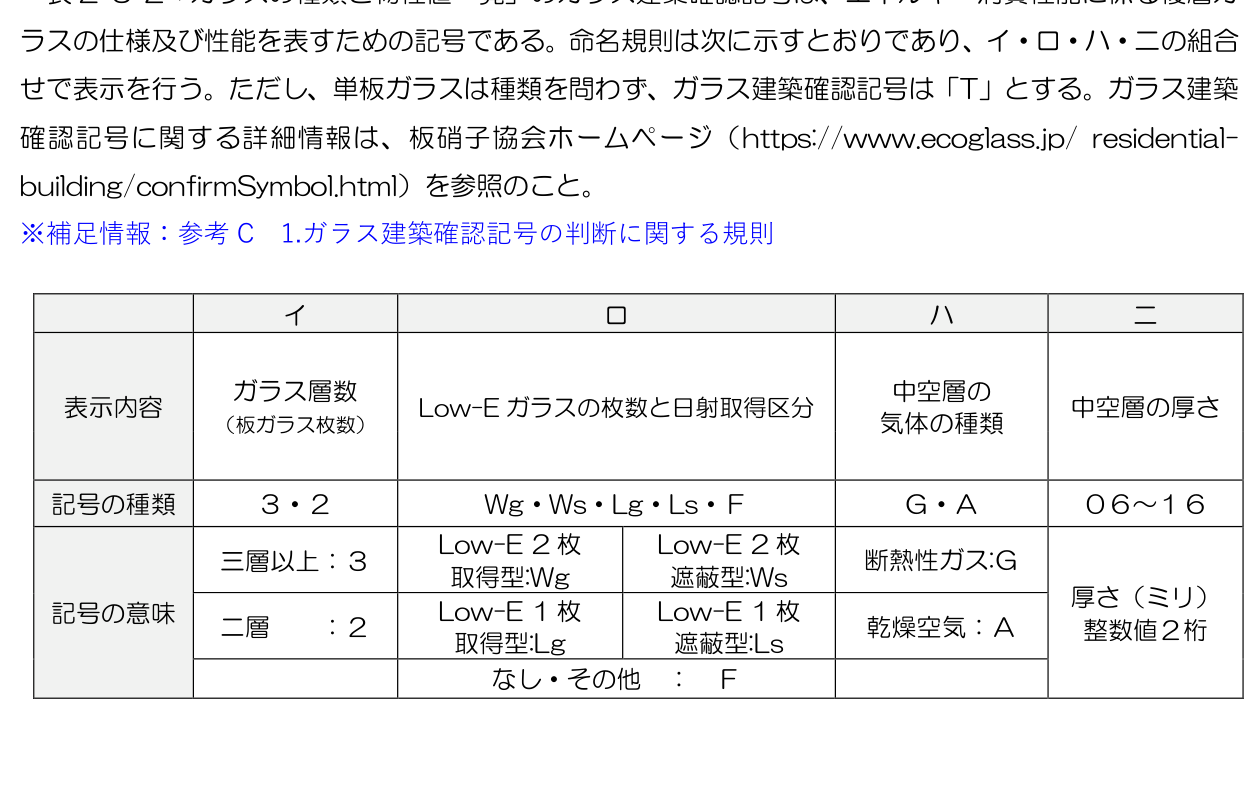
※Supplementary Information: Reference C 1. Regulations Concerning the Determination of the Glass Specification Code for Building Confirmation Applications