Form 2-5 Heat Source Input Sheet
In “Form 2-5 (Air Conditioning) ‘Heat Source Input Sheet’,” information on the specifications of heat source equipment and heat source control methods (such as the operation sequence of heat source devices) shall be entered based on the Air Conditioning Equipment Drawings (equipment list, system diagram, floor plan, automatic control diagram, etc.) in which the specifications of the air-conditioning heat source system are indicated.
Here, the term “heat source group” is defined, as shown in Figure 2-5-1 “Examples of Heat Source Groups,” as a set of multiple heat source system devices (heat source devices, primary pumps, cooling towers, cooling water pumps, etc.) that operate as a single entity in a central heat source type air-conditioning system. In a unitary air-conditioning system, a “heat source group” is defined as the outdoor unit of a packaged air conditioner.
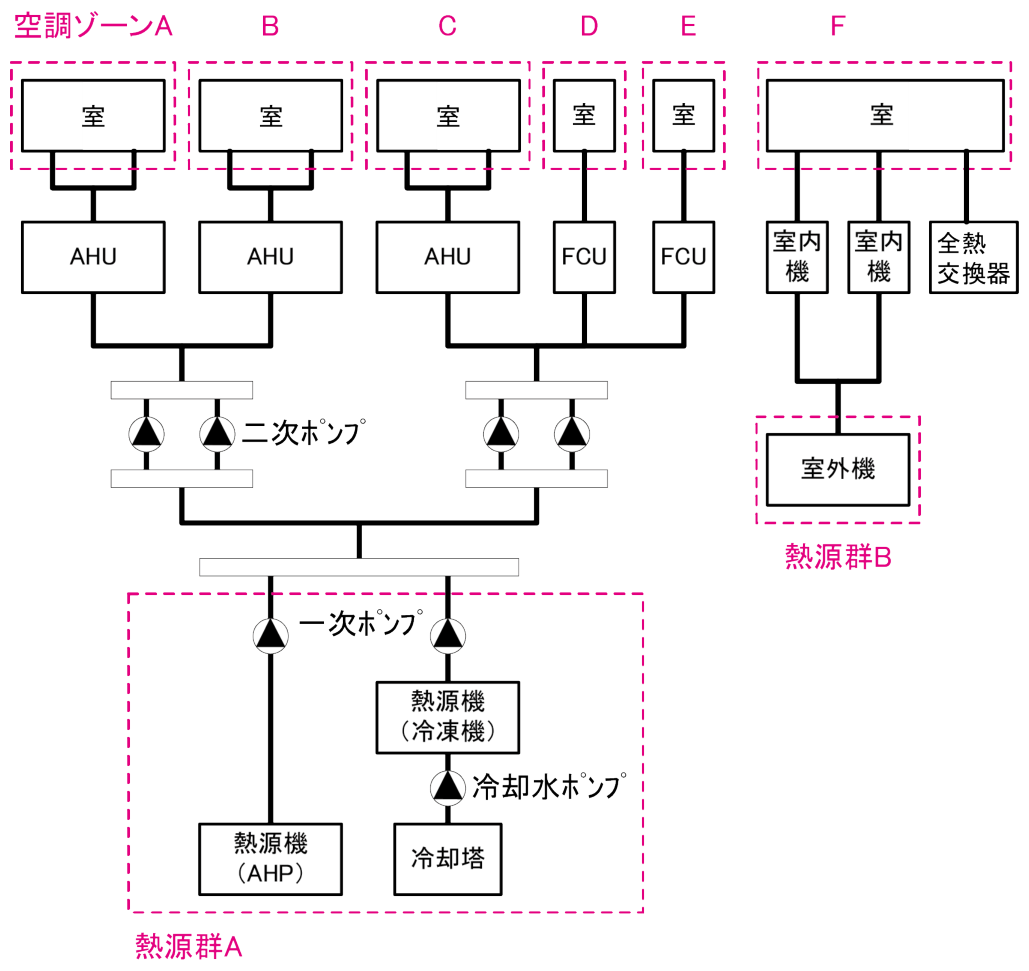
Format of the Heat Source Input Sheet
The format of the “Form 2-5 ‘Heat Source’ input sheet” is shown in Figure 2-5-2.
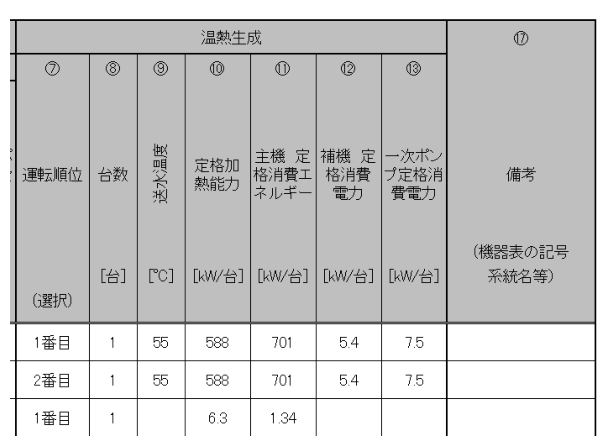
(continued below)
(continued below)
Input Items and Input Method of the Heat Source Input Sheet
The input items and input methods for Form 2-5 "Heat Source Input Sheet" are as follows. The numbers in brackets preceding each item name correspond to the numbers in brackets shown at the top of Figure 2-5-2.
(1) Name of Heat Source Group
- Enter the name of the heat source group using any character string. In the Energy Consumption Performance Calculation Program (Non-Residential Version), the heat source group is identified by this name, so care must be taken to ensure that names are not duplicated.
- When one heat source group is composed of multiple heat source devices, list the specifications of each heat source device consecutively, enter the “Name of Heat Source Group” in the uppermost heat source device, and leave the corresponding field blank for the other heat source devices.
(2) Presence or Absence of Simultaneous Supply Function of Cooling and Heating
- If the heat source group is a system that can simultaneously supply cooling and heating (such as a four-pipe system or a simultaneous cooling/heating operation system), enter “Present.” If the system switches between cooling and heating supply (such as a two-pipe system or a cooling/heating changeover-type system), enter “Absent.”
- For systems where simultaneous supply function of cooling and heating is “Present,” the calculation of energy consumption shall assume that both the heating load in the cooling season and the cooling load in the heating season are handled by the heat source group. For systems where this function is “Absent,” the heating load in the cooling season and the cooling load in the heating season shall not be counted as heat source loads.
(3) Presence or Absence of Control over the Number of Devices
- If there are two or more heat source devices within the same heat source group and the number of operating devices is automatically controlled according to the load, enter “Present.” If control over the number of devices is not performed (i.e., even if multiple devices exist, they always operate simultaneously), enter “Absent.”
- The order of operation of each device shall be entered in “(7) Order of Operation.”
- For heat source groups in which “(4) Heat Storage System Operation Mode” is set to “Supplementary Follow-up Operation,” enter “Present” for “(3) Presence or Absence of Control over the Number of Devices,” even if there is no actual control over the number of devices.
(4) Heat Storage System Operation Mode
- For systems that operate heat source devices at night for heat storage (water heat storage or ice heat storage), select the operation mode from the options in Table 2-5-1 “Heat Storage System Operation Mode” and enter it as a character string. This selection determines the efficiency of the heat storage tank.
- If there is no heat storage system, leave the field blank.
- When one heat source group is composed of multiple heat source devices and even one of them performs heat storage, the relevant heat source group shall be considered a heat storage system.
- If the storage tank is divided into a cooling heat storage tank and a heating heat storage tank, the heat source group itself shall be divided into a cooling heat source group and a heating heat source group.
- When a heat storage system is present, entry of the heat source group with the operation mode of “Supplementary Follow-up Operation” is required.
| Option | Application | Thermal storage tank efficiency |
|---|---|---|
| Water thermal storage (fully-mixed type) | Operation mode in which heat is stored in a connected fully-mixed water thermal storage tank. * A connected fully-mixed water thermal storage tank refers to a connected storage tank in which the mixing in each individual tank can be regarded as complete mixing. (Connected storage tank: a storage tank composed of single tanks connected in series by connecting pipes, or the whole of such tanks.) |
0.8 |
| Water thermal storage (stratified type) | Operation mode in which heat is stored in a temperature-stratified water thermal storage tank. * A temperature-stratified water thermal storage tank refers to a single tank that utilizes the density difference caused by water temperature: warmer (less dense) water stays in the upper part and cooler (denser) water in the lower part of the tank in a stable state, and the water in the tank is moved gently so that the two bodies of water mix as little as possible. |
0.9 |
| Ice thermal storage | Operation mode in which heat is stored in an ice thermal storage unit | 1.0 |
| Supplementary (chasing) operation | Mode operated in the daytime when the heat stored in the storage tank alone is insufficient | - |
(5) Heat Storage System Heat Storage Capacity
- Enter the heat storage capacity (amount of heat) of the heat storage tank as a numerical value. The unit is MJ.
- If there is no heat storage system, leave the field blank.
- The heat storage capacity shall be the value calculated by multiplying the water volume of the heat storage tank (m³) × the temperature difference of the heat storage tank determined by the designer (K) × the specific heat of water (the efficiency of the heat storage tank does not need to be taken into account).
- In the Energy Consumption Performance Calculation Program (Non-Residential Version), the heat loss is calculated as 3% of the heat storage capacity per day.
(6) Heat Source Device Model
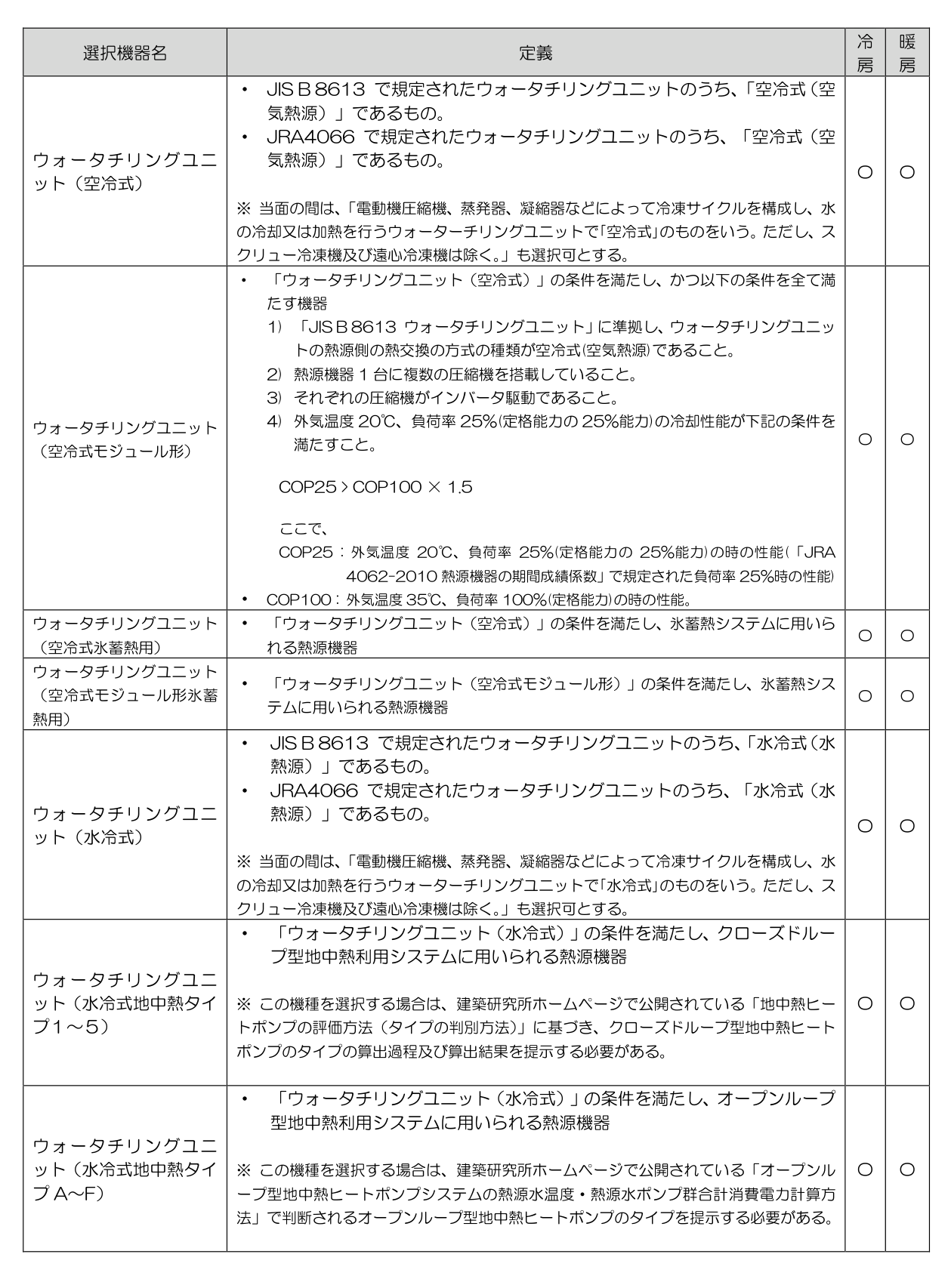
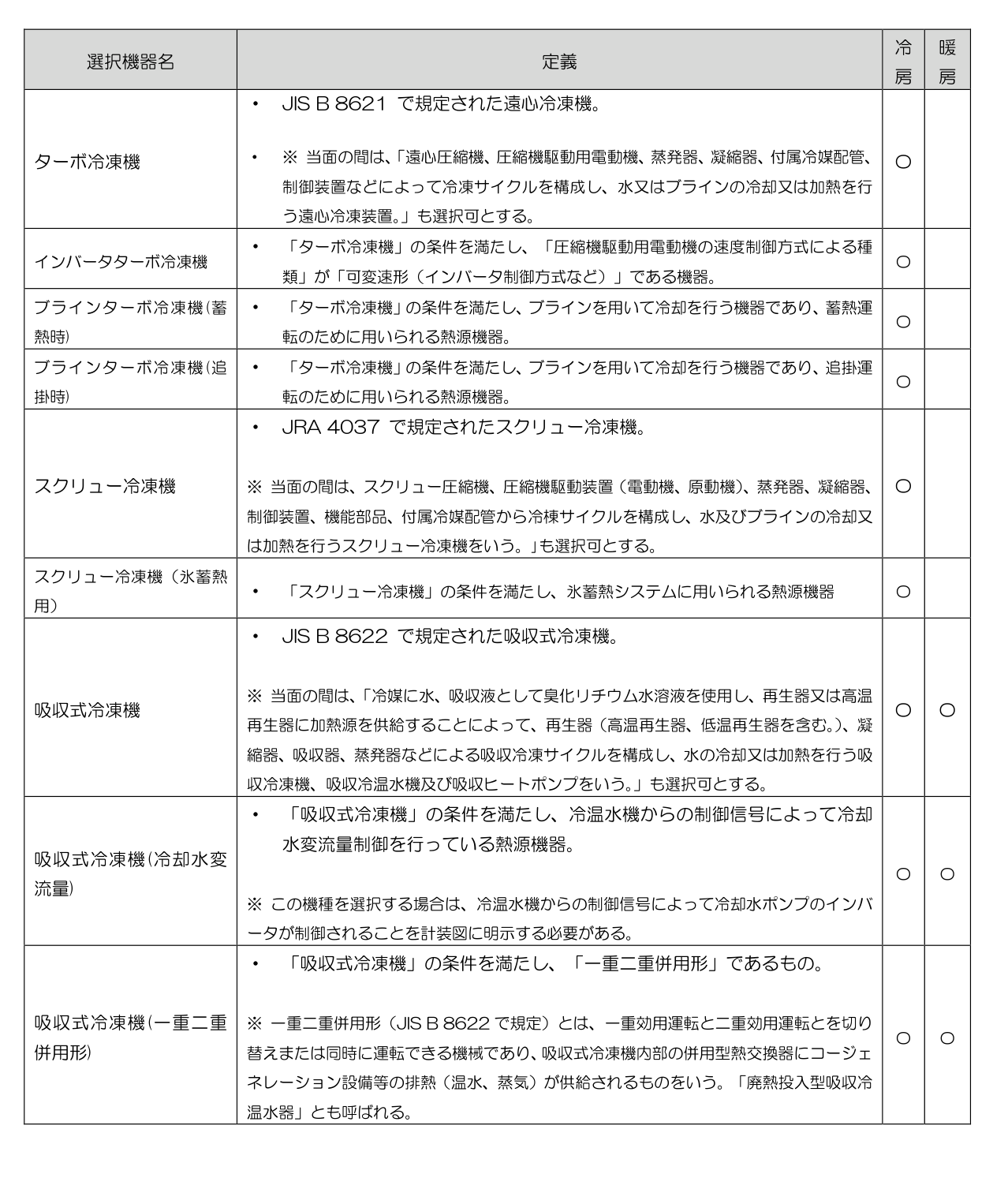
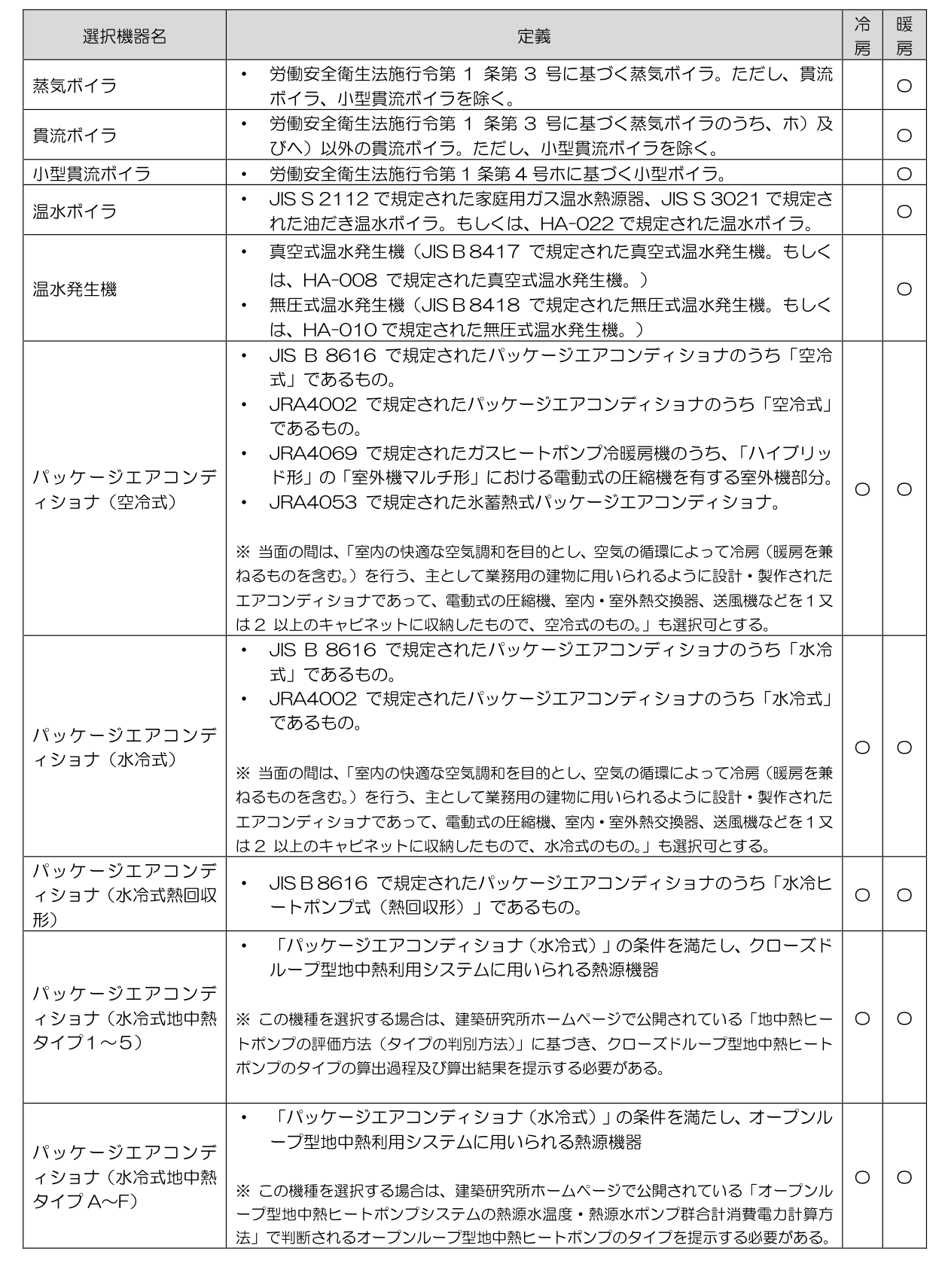
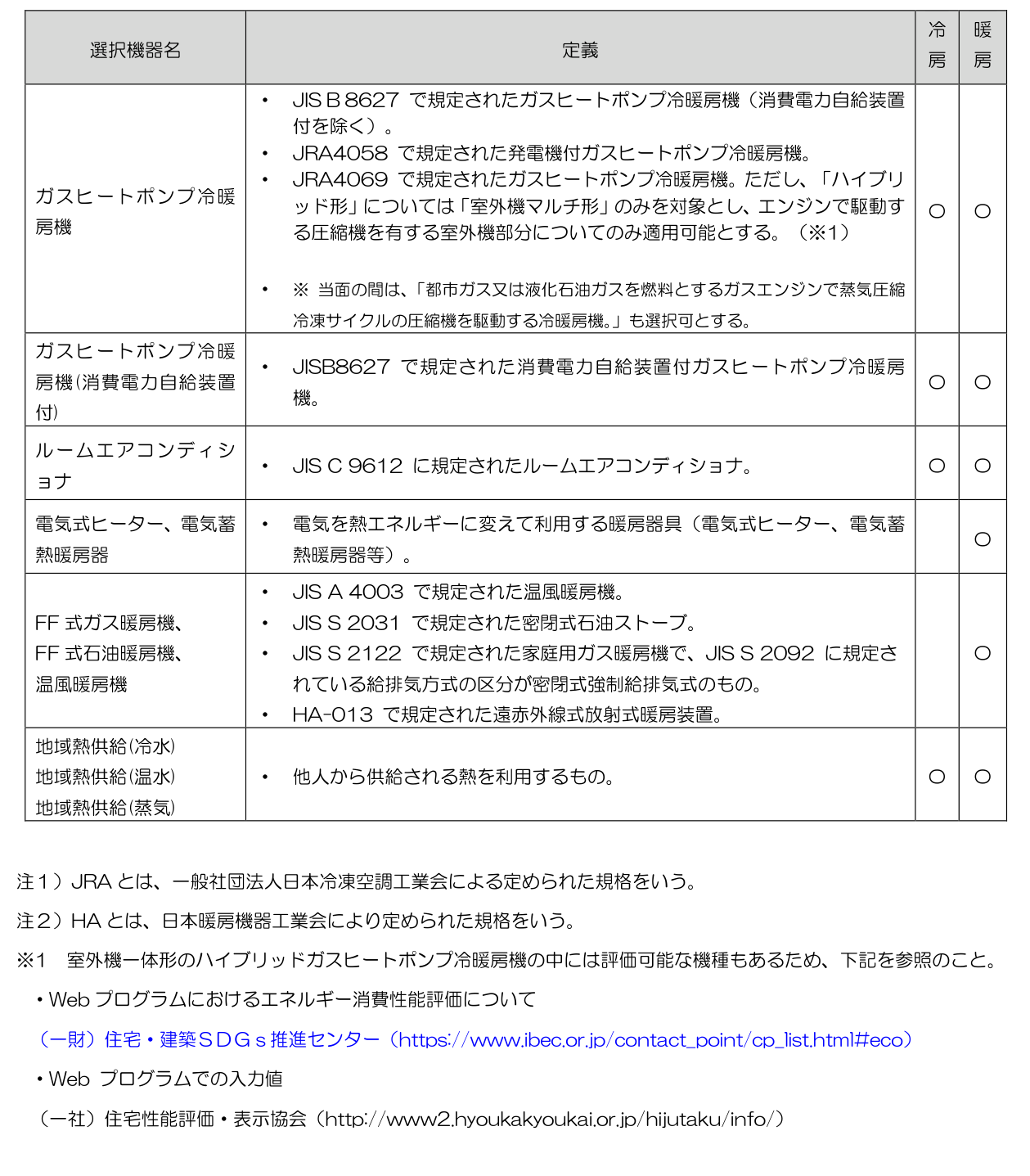
- Select the relevant type of heat source from the options in Table 2-5-2 “List of Heat Source Device Models,” and enter it as a character string.
- Depending on the heat source device model, it is predetermined whether it “supplies cooling heat only,” “supplies heating heat only,” or “is capable of supplying both cooling and heating heat.” Therefore, follow this rule when creating the sheet.
- “Heat Exchanger” is intended to be used when calculating heat exchange with the heat storage tank.
- For determining “Geothermal Heat Types 1–5,” refer to the “Evaluation Method for Ground Source Heat Pumps (Method for Determining Types)” published on the website of the Building Research Institute (BRI), National Research and Development Agency.
- For determining “Geothermal Heat Types A–F,” refer to the “Calculation Method for Heat Source Water Temperature and Total Electric Power Consumption of Heat Source Water Pump Groups in Open-loop Type Geothermal Heat Pump Systems” published on the website of the Building Research Institute (BRI), National Research and Development Agency.
(7) Order of Operation
- When the number of operating heat source devices within the same heat source group is automatically controlled, enter the order of operation for each heat source device. Enter the order of operation as a character string such as “1st,” “2nd,” etc. Use half-width numbers.
- If control over the number of devices is not performed, enter “1st” for all devices.
- If one heat source device constitutes the heat source group, enter “1st.”
- In the case of a heat storage system, enter the order of operation for each of the “heat storage” operation mode and the “supplementary follow-up” operation mode.
| Model | Fuel type | Cooling | Heating |
|---|---|---|---|
| Water chilling unit (air-cooled) | Electricity | 〇 | 〇 |
| Water chilling unit (air-cooled, modular) | Electricity | 〇 | 〇 |
| Water chilling unit (air-cooled, for ice storage) | Electricity | 〇 | 〇 |
| Water chilling unit (air-cooled, modular, for ice storage) | Electricity | 〇 | 〇 |
| Water chilling unit (water-cooled) | Electricity | 〇 | 〇 |
| Water chilling unit (water-cooled, ground-source type 1) | Electricity | 〇 | 〇 |
| Water chilling unit (water-cooled, ground-source type 2) | Electricity | 〇 | 〇 |
| Water chilling unit (water-cooled, ground-source type 3) | Electricity | 〇 | 〇 |
| Water chilling unit (water-cooled, ground-source type 4) | Electricity | 〇 | 〇 |
| Water chilling unit (water-cooled, ground-source type 5) | Electricity | 〇 | 〇 |
| Water chilling unit (water-cooled, ground-source type A) | Electricity | 〇 | 〇 |
| Water chilling unit (water-cooled, ground-source type B) | Electricity | 〇 | 〇 |
| Water chilling unit (water-cooled, ground-source type C) | Electricity | 〇 | 〇 |
| Water chilling unit (water-cooled, ground-source type D) | Electricity | 〇 | 〇 |
| Water chilling unit (water-cooled, ground-source type E) | Electricity | 〇 | 〇 |
| Water chilling unit (water-cooled, ground-source type F) | Electricity | 〇 | 〇 |
| Centrifugal chiller | Electricity | 〇 | |
| Inverter centrifugal chiller | Electricity | 〇 | |
| Brine centrifugal chiller (during charging) | Electricity | 〇 | |
| Brine centrifugal chiller (during supplementary operation) | Electricity | 〇 | |
| Screw chiller | Electricity | 〇 | |
| Screw chiller (for ice storage) | Electricity | 〇 | |
| Absorption chiller (city gas) | City gas | 〇 | 〇 |
| Absorption chiller (LPG) | LPG | 〇 | 〇 |
| Absorption chiller (heavy oil) | Heavy oil | 〇 | 〇 |
| Absorption chiller (kerosene) | Kerosene | 〇 | 〇 |
| Absorption chiller (steam) | Steam | 〇 | |
| Absorption chiller (hot water) | Hot water | 〇 | |
| Absorption chiller (variable cooling water flow, city gas) | City gas | 〇 | 〇 |
| Absorption chiller (variable cooling water flow, LPG) | LPG | 〇 | 〇 |
| Absorption chiller (variable cooling water flow, heavy oil) | Heavy oil | 〇 | 〇 |
| Absorption chiller (variable cooling water flow, kerosene) | Kerosene | 〇 | 〇 |
| Absorption chiller (variable cooling water flow, steam) | Steam | 〇 | |
| Absorption chiller (single/double-effect combined, city gas) | City gas | 〇 | 〇 |
| Absorption chiller (single/double-effect combined, LPG) | LPG | 〇 | 〇 |
| Absorption chiller (single/double-effect combined, steam) | Steam | 〇 | |
| Absorption chiller (single/double-effect combined, variable cooling water flow, city gas) | City gas | 〇 | 〇 |
| Absorption chiller (single/double-effect combined, variable cooling water flow, LPG) | LPG | 〇 | 〇 |
| Absorption chiller (single/double-effect combined, variable cooling water flow, steam) | Steam | 〇 | |
| Steam boiler (city gas) | City gas | 〇 | |
| Steam boiler (LPG) | LPG | 〇 | |
| Steam boiler (heavy oil) | Heavy oil | 〇 | |
| Steam boiler (kerosene) | Kerosene | 〇 | |
| Once-through boiler (city gas) | City gas | 〇 | |
| Once-through boiler (LPG) | LPG | 〇 | |
| Once-through boiler (heavy oil) | Heavy oil | 〇 | |
| Once-through boiler (kerosene) | Kerosene | 〇 | |
| Small once-through boiler (city gas) | City gas | 〇 | |
| Small once-through boiler (LPG) | LPG | 〇 | |
| Small once-through boiler (heavy oil) | Heavy oil | 〇 | |
| Small once-through boiler (kerosene) | Kerosene | 〇 | |
| Hot water boiler (city gas) | City gas | 〇 | |
| Hot water boiler (LPG) | LPG | 〇 | |
| Hot water boiler (heavy oil) | Heavy oil | 〇 | |
| Hot water boiler (kerosene) | Kerosene | 〇 | |
| Hot water generator (city gas) | City gas | 〇 | |
| Hot water generator (LPG) | LPG | 〇 | |
| Hot water generator (heavy oil) | Heavy oil | 〇 | |
| Hot water generator (kerosene) | Kerosene | 〇 | |
| Packaged air conditioner (air-cooled) | Electricity | 〇 | 〇 |
| Packaged air conditioner (water-cooled) | Electricity | 〇 | 〇 |
| Packaged air conditioner (water-cooled, heat recovery) | Electricity | 〇 | 〇 |
| Packaged air conditioner (water-cooled, ground-source type 1) | Electricity | 〇 | 〇 |
| Packaged air conditioner (water-cooled, ground-source type 2) | Electricity | 〇 | 〇 |
| Packaged air conditioner (water-cooled, ground-source type 3) | Electricity | 〇 | 〇 |
| Packaged air conditioner (water-cooled, ground-source type 4) | Electricity | 〇 | 〇 |
| Packaged air conditioner (water-cooled, ground-source type 5) | Electricity | 〇 | 〇 |
| Packaged air conditioner (water-cooled, ground-source type A) | Electricity | 〇 | 〇 |
| Packaged air conditioner (water-cooled, ground-source type B) | Electricity | 〇 | 〇 |
| Packaged air conditioner (water-cooled, ground-source type C) | Electricity | 〇 | 〇 |
| Packaged air conditioner (water-cooled, ground-source type D) | Electricity | 〇 | 〇 |
| Packaged air conditioner (water-cooled, ground-source type E) | Electricity | 〇 | 〇 |
| Packaged air conditioner (water-cooled, ground-source type F) | Electricity | 〇 | 〇 |
| Gas heat pump air conditioner (city gas) | City gas | 〇 | 〇 |
| Gas heat pump air conditioner (LPG) | LPG | 〇 | 〇 |
| Gas heat pump air conditioner (with self-power-supply device, city gas) | City gas | 〇 | 〇 |
| Gas heat pump air conditioner (with self-power-supply device, LPG) | LPG | 〇 | 〇 |
| Room air conditioner | Electricity | 〇 | 〇 |
| Electric heater | Electricity | 〇 | |
| Electric thermal storage heater | Electricity | 〇 | |
| FF-type gas heater (city gas) | City gas | 〇 | |
| FF-type gas heater (LPG) | LPG | 〇 | |
| FF-type oil heater | Kerosene | 〇 | |
| Warm air heater (city gas) | City gas | 〇 | |
| Warm air heater (LPG) | LPG | 〇 | |
| Warm air heater (heavy oil) | Heavy oil | 〇 | |
| Warm air heater (kerosene) | Kerosene | 〇 | |
| District heat supply (chilled water) | Chilled water | 〇 | |
| District heat supply (hot water) | Hot water | 〇 | |
| District heat supply (steam) | Steam | 〇 | |
| Heat exchanger | Electricity | 〇 | 〇 |
(8) Number of Devices
- Enter the number of the same heat source devices as a numerical value.
- Note that the entered number of devices is independent of the Control over the Number of Devices entered in “(7) Order of Operation,” and all devices always operate simultaneously.
(9) Water Supply Temperature
- Enter the outlet temperature of the chilled water, hot water, or brine, etc., from the heat source during cooling heat generation and heating heat generation as a numerical value. The unit is °C.
(10) Rated Cooling Capacity / Rated Heating Capacity
- Enter the rated cooling capacity and rated heating capacity per heat source device as numerical values. The unit is kW/device.
- The rated cooling capacity and rated heating capacity to be entered here shall be the performance values under the standard rated conditions specified by JIS, etc. (chilled / hot water temperature, cooling water temperature, and flow rate, etc.)
- For dehumidifying outside air processing devices, for the time being, select “Packaged Air Conditioner (Air-cooled Type)” as the heat source device model, and enter the performance values specified in the “Performance Testing and Indication Method for Dehumidifying Outside Air Processing Devices” published on the website of the Building Research Institute (BRI).
- For hot-water floor heating with room air conditioners, for the time being, select “Room Air Conditioner” as the heat source device model, and, in principle, enter the performance values of the air conditioner in its standalone operation.
(11) Main Heat Source Module Rated Energy Consumption
- Enter the rated energy consumption of the relevant Heat Source Main Module as a numerical value.
- When the energy source of the heat source device is “electricity,” enter the rated power consumption [kW/device]; when it is “gas” or “oil,” enter the fuel consumption (converted to primary energy) [kW/device]. For example:
In the case of kerosene 0.5 L/h, using the primary energy conversion coefficient of 37,000 kJ/L, the value should be 0.5 L/h × 37,000 kJ/L ÷ 3,600 = 5.14 kW.
Similarly, in the case of heavy oil 0.5 L/h, the value should be 0.5 L/h × 41,000 kJ/L ÷ 3,600 = 5.69 kW.
- The rated energy consumption to be entered here shall be the value under the standard rated conditions specified by JIS, etc. (chilled / hot water temperature, cooling water temperature, and flow rate, etc.)
- It is assumed that the energy consumption of the Heat Source Main Module varies depending on the equipment load factor and the outside air temperature, and the value under each condition shall be calculated using the characteristic curve of the heat source.
- For unitary / distributed air-conditioning systems (such as packaged air conditioners, gas-engine heat pump cooling / heating units, and room air conditioners) in which only the outdoor unit (or only the indoor unit) is powered, as a rule, enter the total power consumption of the outdoor and indoor units in “(11): Heat Source Main Module Rated Energy Consumption” on Form 2-5 “Heat Source Input Sheet,” and enter “0” in “(7)(8)(9)(10): Supply Fan Rated Power Consumption” on Form 2-7 (Air Conditioning) “Air Conditioner Input Sheet.”
(12) Heat Source Auxiliary Unit Rated Power Consumption
- Enter the rated power consumption of the relevant auxiliary unit of the heat source device (such as solution pumps, refrigerant pumps, feedwater pumps, vacuum pumps, fans, and heaters attached to the Heat Source Main Module, excluding those whose power consumption is included in the rated energy consumption of the main module) as a numerical value. The unit is kW/unit.
- The rated power consumption to be entered here shall be the value under the standard rated conditions specified by JIS, etc. (chilled / hot water temperature, cooling water temperature, and flow rate, etc.)
- The power consumption of the auxiliary unit of the heat source device is assumed to vary in proportion to the equipment load factor (however, it remains constant when the load factor is 30% or less).
- The “Electric motor output” may be regarded as the power consumption.
- Primary pumps and cooling towers are not considered auxiliary units; their specifications shall be entered in (13) to (16).
(13) Primary Pump Rated Power Consumption
- Enter the rated power consumption of the primary pump connected to each heat source device as a numerical value. The unit is kW / device, and the value per one heat source device shall be entered (note that the denominator is the number of heat source devices in “(8) Number of Devices,” not the number of primary pumps).
- The “Electric motor output” may be regarded as the power consumption.
- For systems in which the primary pump also serves as the secondary pump, enter the value in this field as a primary pump.
- Under the Energy Conservation Standard, the effect of variable flow control of primary pumps cannot be evaluated as an energy-saving measure. All primary pumps shall be calculated as “Constant Flow Rate.”
- For air conditioning systems where the heat source device model is “Water Chilling Unit (Water-cooled Geothermal Type 1–5)” or “Packaged Air Conditioner (Water-cooled Geothermal Type 1–5)” and that have an independent pump for circulating heat source water between the geothermal heat exchanger and the heat source device, add the rated power consumption (in kW/unit, or the total value if multiple pumps exist) of such pumps and enter the value in this field.
- For systems where the heat source device model is “Water Chilling Unit (Water-cooled Geothermal Type A–F)” or “Packaged Air Conditioner (Water-cooled Geothermal Type A–F)” and that have one or more pumps for circulating heat source water between the pumping well and the heat source device, enter the “total power consumption of the heat source water pump group” calculated according to the “Calculation Method for Heat Source Water Temperature and Total Power Consumption of Heat Source Water Pump Groups in Open-loop Geothermal Heat Pump Systems” published on the website of the Building Research Institute (BRI).
(14) Rated Cooling Capacity of Cooling Tower
- Enter the cooling capacity of the cooling tower per one heat source device as a numerical value. The unit is kW/device.
- If no cooling tower is installed, leave the field blank.
- When multiple heat source devices are connected to one cooling tower, enter the apportioned value of the rated cooling capacity of the cooling tower according to the capacity of each heat source device.
(15)(16) Power Consumption of Cooling Tower Fan / Power Consumption of Cooling Tower Pump
- Enter the power consumption of the cooling tower fan and cooling tower pump per one heat source device. The unit is kW/device.
- The “Electric motor output” may be regarded as the power consumption.
- If no cooling tower is installed, leave the field blank.
(17) Remarks (Symbols, System Names, etc., in the Equipment List)
- This field is for memos during data entry and is not used in the calculation, so entry is optional.
- It is recommended to enter symbols, system names, etc., as shown in the equipment list.
(This table is provided in Japanese. An HTML version is planned for a future update.)
| Heat source model | Item | Definition | |
|---|---|---|---|
| Water chilling unit (air-cooled), water chilling unit (air-cooled, modular), water chilling unit (water-cooled), water chilling unit (water-cooled, ground-source) | Rated capacity (cooling) | ・ "Rated cooling capacity" specified in JIS B 8613・"Rated cooling capacity" specified in JRA 4066 | |
| Heating | ・ "Rated heat pump heating capacity" specified in JIS B 8613・"Rated heat pump heating capacity" specified in JRA 4066 | ||
| Rated power consumption (cooling) | ・ "Rated cooling power consumption" specified in JIS B 8613・"Rated cooling power consumption" specified in JRA 4066 | ||
| Heating | ・ "Rated heat pump heating power consumption" specified in JIS B 8613・"Rated heat pump heating power consumption" specified in JRA 4066 | ||
| Rated fuel consumption | Set to 0. | ||
| Centrifugal chiller, inverter centrifugal chiller, brine centrifugal chiller | Rated capacity (cooling) | ・ "Rated refrigerating capacity (standard rating)" specified in JIS B 8621 | |
| Rated power consumption (cooling) | ・ "Rated refrigerating input (standard rating)" specified in JIS B 8621 | ||
| Rated fuel consumption | Set to 0. | ||
| Screw chiller, screw chiller (for ice storage) | Rated capacity (cooling) | ・ "Rated refrigerating capacity" specified in JRA 4037 | |
| Rated power consumption (cooling) | ・ "Rated compressor refrigerating input" specified in JRA 4037 | ||
| Rated fuel consumption | Set to 0. | ||
| Absorption chiller, absorption chiller (variable cooling water flow), absorption chiller (single/double-effect combined) | Rated capacity (cooling) | ・ "Rated refrigerating capacity (standard rating)" specified in JIS B 8622 | |
| Heating | ・ "Rated heating capacity (standard rating)" specified in JIS B 8622 | ||
| Rated power consumption (cooling) | ・ "Power consumption (standard rating)" specified in JIS B 8622 | ||
| Heating | ・ "Power consumption (standard rating)" specified in JIS B 8622 | ||
| Rated fuel consumption (cooling) | ・ "Heat source heat consumption (standard rating)" specified in JIS B 8622 | ||
| Heating | ・ "Heat source heat consumption (standard rating)" specified in JIS B 8622 | ||
| Steam boiler, once-through boiler, small once-through boiler, hot water boiler | Rated capacity | Heating | ・ [Steam boiler] "Heat output (indicated)" specified in the Steam Boiler Performance Indication Guidelines・[Once-through boiler] "Heat output (indicated)" specified in the Once-through Boiler Performance Indication Guidelines・[Small once-through boiler] "Heat output (indicated)" specified in the Small Once-through Boiler Performance Indication Guidelines・[Hot water boiler] "Heat output" specified in JIS S 2112; "Heating output" specified in JIS S 3021; "Heat output" specified in the Hot Water Generator / Hot Water Boiler Performance Indication Guidelines |
| Rated power consumption | Heating | ・ [Steam boiler] "Equipment power (indicated)" specified in the Steam Boiler Performance Indication Guidelines・[Once-through boiler] "Equipment power (indicated)" specified in the Once-through Boiler Performance Indication Guidelines・[Small once-through boiler] "Equipment power (indicated)" specified in the Small Once-through Boiler Performance Indication Guidelines・[Hot water boiler] "Rated power consumption" specified in JIS S 2112; "Rated power consumption" specified in JIS S 3021; "Rated power consumption" specified in the Hot Water Generator / Hot Water Boiler Performance Indication Guidelines | |
| Rated fuel consumption | Heating | ・ [Steam boiler] "Fuel consumption (indicated) [kW]" specified in the Steam Boiler Performance Indication Guidelines・[Once-through boiler] "Fuel consumption (indicated) [kW]" specified in the Once-through Boiler Performance Indication Guidelines・[Small once-through boiler] "Fuel consumption (indicated) [kW]" specified in the Small Once-through Boiler Performance Indication Guidelines・[Hot water boiler] "Gas consumption" specified in JIS S 2112; the value of "Fuel consumption" specified in JIS S 3021 converted to the lower heating value basis (*); "Rated fuel consumption" specified in the Hot Water Generator / Hot Water Boiler Performance Indication Guidelines | |
| Hot water generator | Rated capacity | Heating | ・ "Heat output" specified in the Hot Water Generator / Hot Water Boiler Performance Indication Guidelines |
| Rated power consumption | Heating | ・ "Rated power consumption" specified in the Hot Water Generator / Hot Water Boiler Performance Indication Guidelines | |
| Rated fuel consumption | Heating | ・ "Rated fuel consumption" specified in the Hot Water Generator / Hot Water Boiler Performance Indication Guidelines | |
| Packaged air conditioner (air-cooled), packaged air conditioner (water-cooled), packaged air conditioner (water-cooled, heat recovery), packaged air conditioner (water-cooled, ground-source) | Rated capacity | Cooling | ・ "Rated standard cooling capacity" specified in JIS B 8616・"Rated standard cooling capacity" specified in JRA 4002・"Rated cooling capacity without thermal storage" specified in JRA 4053・"Rated standard cooling capacity" specified in JRA 4069 (*1) |
| Heating | ・ "Rated standard heating capacity" specified in JIS B 8616・"Rated standard heating capacity" specified in JRA 4002・"Rated standard heating capacity without thermal storage" specified in JRA 4053・"Rated standard heating capacity" specified in JRA 4069 (*1) | ||
| Rated power consumption | Cooling | ・ "Rated standard cooling power consumption" specified in JIS B 8616・"Rated standard cooling power consumption" specified in JRA 4002・"Rated cooling power consumption without thermal storage" specified in JRA 4053・"Rated standard cooling power consumption" specified in JRA 4069 (*1) | |
| Heating | ・ "Rated standard heating power consumption" specified in JIS B 8616・"Rated standard heating power consumption" specified in JRA 4002・"Rated standard heating power consumption without thermal storage" specified in JRA 4053・"Rated standard heating power consumption" specified in JRA 4069 (*1) | ||
| Rated fuel consumption | Set to 0 | ||
| Gas heat pump air conditioner; gas heat pump air conditioner (with self-power-supply device) | Rated capacity | Cooling | ・ "Rated standard cooling capacity" specified in JIS B 8627・"Rated standard cooling capacity" specified in JRA 4058・"Rated standard cooling capacity" specified in JRA 4069 (*1)・"Rated cooling capacity" specified in JRA 4069 (*2) * For "gas heat pump air conditioner (with self-power-supply device)," enter the performance during power generation. |
| Heating | ・ "Rated standard heating capacity" specified in JIS B 8627・"Rated standard heating capacity" specified in JRA 4058・"Rated standard heating capacity" specified in JRA 4069 (*1)・"Rated heating capacity" specified in JRA 4069 (*2) * For "gas heat pump air conditioner (with self-power-supply device)," enter the performance during power generation. |
||
| Rated power consumption | Cooling | ・ "Rated standard cooling power consumption" specified in JIS B 8627・"Rated standard cooling power consumption (without power generation)" specified in JRA 4058・"Rated standard cooling power consumption" specified in JRA 4069 (*1)・"Rated cooling power consumption" specified in JRA 4069 (*2) * For "gas heat pump air conditioner (with self-power-supply device)," enter the performance during power generation. |
|
| Heating | ・ "Rated standard heating power consumption" specified in JIS B 8627・"Rated standard heating power consumption (without power generation)" specified in JRA 4058・"Rated standard heating power consumption" specified in JRA 4069 (*1)・"Rated heating power consumption" specified in JRA 4069 (*2) * For "gas heat pump air conditioner (with self-power-supply device)," enter the performance during power generation. |
||
| Rated fuel consumption | Cooling | ・ "Rated standard cooling gas consumption" specified in JIS B 8627・"Rated standard cooling gas consumption (without power generation)" specified in JRA 4058・"Rated standard cooling gas consumption" specified in JRA 4069 (*1)・"Rated cooling gas consumption" specified in JRA 4069 (*2) * For "gas heat pump air conditioner (with self-power-supply device)," enter the performance during power generation. |
|
| Heating | ・ "Rated standard heating gas consumption" specified in JIS B 8627・"Rated standard heating gas consumption (without power generation)" specified in JRA 4058・"Rated standard heating gas consumption" specified in JRA 4069 (*1)・"Rated heating gas consumption" specified in JRA 4069 (*2) * For "gas heat pump air conditioner (with self-power-supply device)," enter the performance during power generation. |
||
| Room air conditioner | Rated capacity | Cooling | ・ "Rated cooling capacity" specified in JIS C 9612 |
| Heating | ・ "Rated standard heating capacity" specified in JIS C 9612 | ||
| Rated power consumption | Cooling | ・ "Rated cooling power consumption" specified in JIS C 9612 | |
| Heating | ・ "Rated standard heating power consumption" specified in JIS C 9612 | ||
| Rated fuel consumption | Set to 0 | ||
| Electric heater, electric thermal storage heater | Rated capacity | Heating | ・ Electrical capacity of the electric heater, etc. |
| Rated power consumption | Heating | ・ Rated power consumption of the electric heater, etc. | |
| Rated fuel consumption | Set to 0 | ||
| FF-type gas heater, FF-type oil heater, warm air heater | Rated capacity | Heating | ・ "Rated heating capacity" specified in JIS A 4003・"Rated heating output" specified in JIS S 2031・The value of "indicated gas consumption" specified in JIS S 2122 multiplied by "thermal efficiency" and divided by 100 (JIS S 2122 Table 3)・"Heating capacity" specified in HA-013 |
| Rated power consumption | Heating | ・ "Rated power consumption" specified in JIS A 4003・"Rated power consumption" specified in JIS S 2031・"Rated power consumption" specified in JIS S 2122・"Rated power consumption" specified in HA-013 | |
| Rated fuel consumption | Heating | ・ "Rated fuel consumption" specified in JIS A 4003・"(Maximum) fuel consumption" specified in JIS S 2031・"Indicated gas consumption" specified in JIS S 2122・"Fuel consumption" specified in HA-013 | |
| District heat supply (chilled water), district heat supply (hot water), district heat supply (steam) | Rated capacity | ・ Heat supply amount described in the design documents. | |
| Rated power consumption | ・ Set to 0. | ||
| Rated fuel consumption | ・ The rated capacity multiplied by the "primary energy conversion value of heat supplied by others." (See Chapter 1, Section 3, "Primary Energy Conversion Coefficient of 'Heat Supplied by Others'") |