Primary Energy Conversion Coefficient of “Heat Supplied by Others”
The primary energy conversion coefficient of “Heat Supplied by Others (steam, hot water, chilled water)” is stipulated as shown in Table 1-3-1 in the Supplementary Table 1 of the Notification of the Energy Efficiency Standards, and it is permitted to use an arbitrary conversion coefficient if the basis for the calculation can be clearly indicated.
(This table is provided in Japanese. An HTML version is planned for a future update.)
In this section, three examples are provided for the calculation methods and supporting materials of the primary energy conversion coefficient of “heat supplied by others”. In any case, the primary energy conversion coefficient described in the supporting materials submitted at the time of the building confirmation application (compliance judgment) for the relevant building shall remain valid until the completion inspection of the relevant building is completed.
Method (1): Using the published data in the Heat Supply Business Handbook (Japan Heat Supply Business Association)
In the Heat Supply Business Handbook, the amount of heat sold and the amount of raw material and fuel consumed are published for each heat supply business operator. Calculate the conversion coefficient using the values indicated in the latest edition of the Heat Supply Business Handbook as of the time of the building confirmation application.
(Example of Calculation Method)
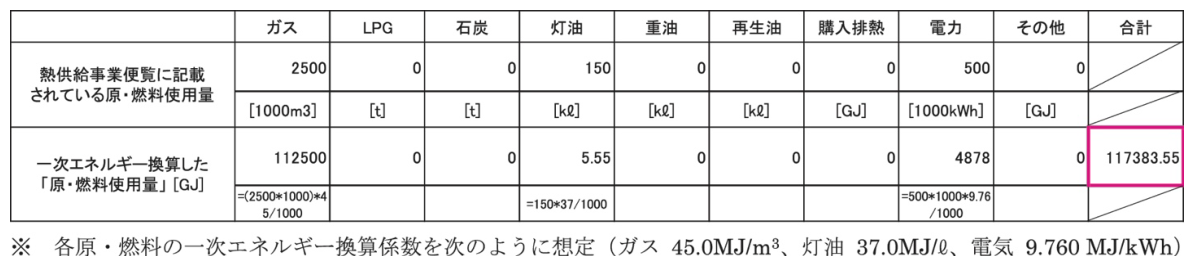
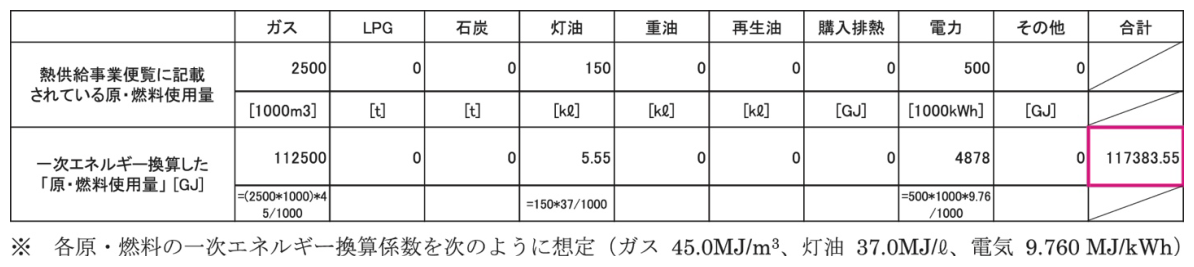
Calculate the conversion coefficient using the “Amount of Heat Sold (GJ)” and “Raw Material and Fuel Consumed” described in “2. Overview of Heat Supply Business Operators / (2) Overview by Heat Supply Area / (1) Overview of Supply Area” of the Heat Supply Business Handbook (see Table 1-3-2). It should be noted that the value in the “Total” column under “Raw Material and Fuel Consumed” is the total obtained by converting electricity consumption to secondary energy. Therefore, it is necessary to separately calculate “the total value obtained by converting each energy of raw material and fuel consumed to primary energy.”
Primary energy conversion coefficient =
“Total value obtained by summing up the values converted from each energy of raw material and fuel consumed to primary energy” / “Amount of heat sold”
(This table is provided in Japanese. An HTML version is planned for a future update.)
Method (2): Using the data published by the administrative agency based on ordinances, etc.
For example, in the case of Tokyo, the “Regional Energy Supply Performance Report” is published on the following page.
When using the value of “Thermal Energy Efficiency” in “7. Efficiency Values and Evaluation of Energy Supplied” of this “Regional Energy Supply Performance Report”, the reciprocal of the value shall be used. If the planned value of thermal energy efficiency for planned new or renovated district heating and cooling facilities is published based on ordinances, such value may also be used.
Method (3): Using the values calculated based on the “Guidelines for Calculation of Conversion Coefficients for Cooling Heat and Heating Heat in Heat Supply Business” established by Japan Heat Supply Business Association
The primary energy conversion coefficients for cooling heat and heating heat calculated based on the “Guidelines for Calculation of Conversion Coefficients for Cooling Heat and Heating Heat in Heat Supply Business (Japan Heat Supply Business Association, No. 29 Heat–96, established June 30, 2017)” may be used.
“Guidelines for Calculation of Conversion Coefficients for Cooling Heat and Heating Heat in Heat Supply Business” (Japan Heat Supply Business Association)
Only in the case of Method (3), the primary energy conversion coefficients may be entered separately for cooling heat (chilled water) and heating heat (hot water and steam). For Methods (1) and (2), the same value shall be entered for both cooling heat and heating heat primary energy conversion coefficients.